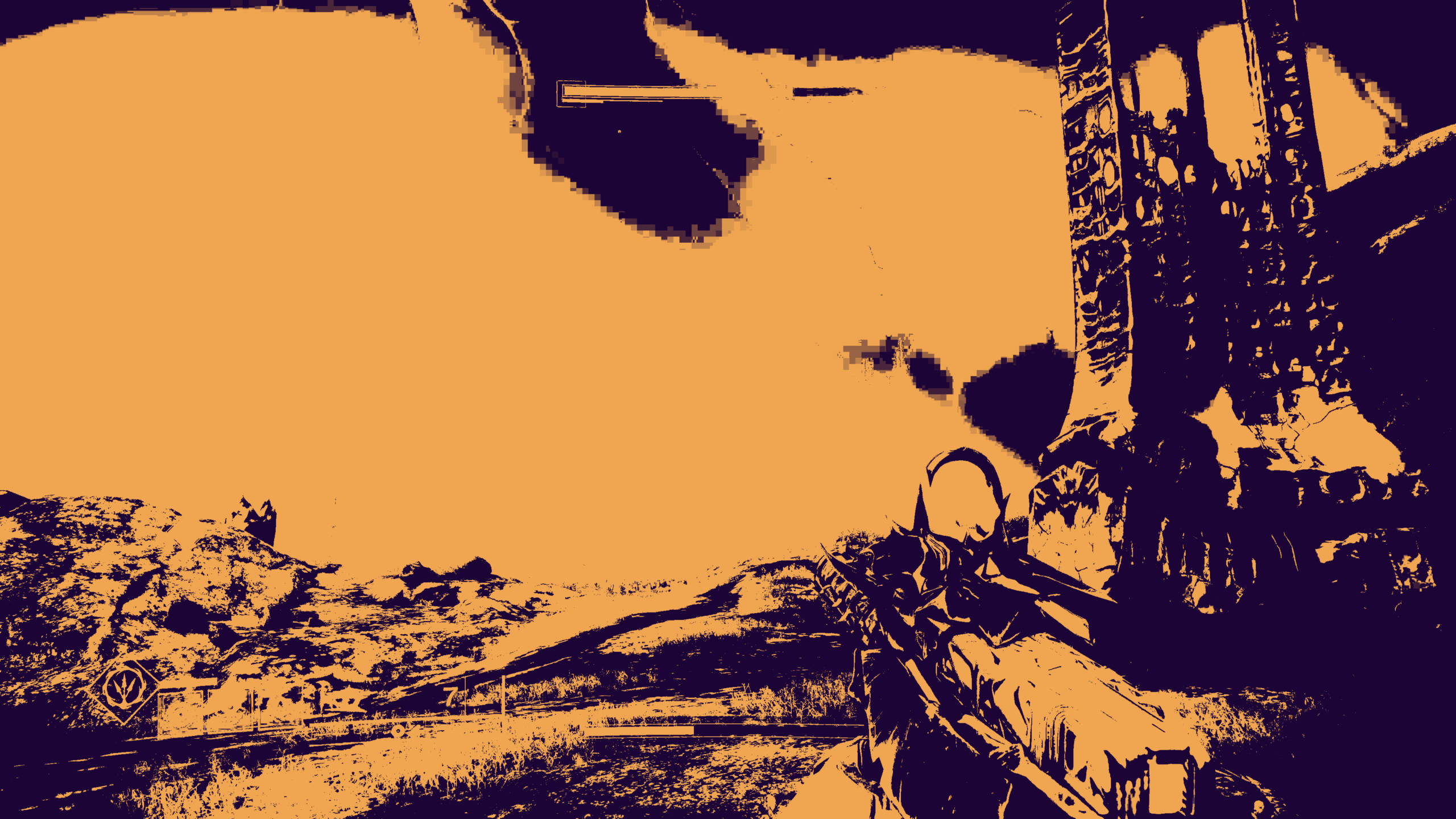
In their thesis The Heroes We Never Are: Interpellation, Subjugation, and the Encoded Other in Fantasy CRPGs, narrative designer Axel Hassen Taiari writes, “Can players refuse (to) define the hero on machinic terms and thus reject these dynamics? At best, only briefly.” He continues: “There is no way to complete the Baldur’s Gate series—in other words, to turn the text’s final page—without gradually mythologizing the Ward through power.” Here Taiari was talking about classic, lengthy, and methodical computer role-playing games (CRPGs), games whose foundational texts spanned millions of words and dozens if not hundreds of hours of sustained play. What would happen if a game took that slow process of mythmaking and power accumulation and compressed it, essentially creating a space where the computational hero’s journey took place instantly?
I don’t think Bungie, Inc., the studio that develops the Destiny series, purposely set out to test this hypothesis. But through several public memos from the game’s development team, including a three-part Director’s Cut blog series by then-director Luke Smith, we do get a sense of what Bungie wants out of Destiny 2: an “awesome power fantasy” in a “universe that is going somewhere” that culminates in an “amazing action MMO in a single evolving world that you can play anywhere, anytime with your friends.” In other words, Bungie wants Destiny 2 to be the perfect blend of quick-hit and endlessly replayable live-service gaming mixed with long-term massively multiplayer online game (MMO) richness amid a base of the studio’s lauded first person shooter gameplay.
This has ostensibly been their goal since the original permutation of Destiny, but that game still basically adheres to a regular RPG’s scale of power and progression. With Destiny 2, Bungie has implemented a bevy of mechanical and narrative tweaks to empower new players as quickly as possible and keep existing players in the game for as long as possible. This sensible business strategy for a live-service game has strange implications for the narrative aspects of the game’s more traditional MMORPG side, namely that it makes the player-character Guardians a kind of “Omnihero” whose past, present, and future heroics are all already a given. The result is that the game’s non-player characters and storylines have become a secondary concern.